

advisor marketing
How Advisors Win Clients in the Age of AI Discovery
Capital Turbine · · 8 min read

AI has changed how prospects find you. A stronger brand determines whether they choose you. A prospect might first hear your name from ChatGPT or a Google AI Overview, but before they pick up the phone, they're on your website, reading your content, forming an opinion about whether you're the right fit.Having a presence isn't enough anymore. You need a broad presence, a reliable message, and consistent design language that speaks to the exact people you're trying to reach. Because in a world where AI surfaces three or four advisors by name and stops there, the ones who get picked are the ones who are remembered.
Every potential client is asking themselves one question when they visit your website: "do people like me work with advisors like this?"
The Market Is Growing. So Is the Competition.
Demand for advice has never been higher. The number of clients served by registered investment advisers increased 7.7% to 73.7 million in 2025, and assets under management reached a record $176.8 trillion, according to the 2026 Investment Adviser Industry Snapshot. The number of registered firms hit a record high too, at 16,544. More potential clients, more advisors chasing them.
The advisors who stand out in that environment aren't necessarily the biggest or the cheapest. They're the ones with a clear, consistent identity, a brand that makes it immediately obvious who they serve and why they're the right choice for that specific person. That clarity has always mattered. What's changed is that AI now acts as a filter before a prospect ever types your name into a search bar.
The New Discovery Path: AI First, Brand Second
Prospects are starting their search in places that didn't exist a few years ago. According to Wealthtender's 2025 study of 500 affluent households, 25% of consumers already plan to use ChatGPT, Gemini, or other AI-powered tools to start their advisor search. Instead of typing "financial advisor near me" into Google, they're submitting detailed prompts, things like "I need a fiduciary advisor in Denver who works with tech executives going through a liquidity event." AI reads your content, your bio, your niche, and decides whether you're worth recommending.
And here's where brand becomes the deciding factor: 96% of consumers research multiple advisors online before deciding who to hire, including the ones who found you through AI. Every single one of those people lands on your website before they contact you. Choosing a financial advisor is one of the most significant financial decisions a person makes. They do their homework. Think about ordering from a restaurant you've never tried: even with a glowing recommendation from a friend, you still pull up the menu, check the photos, read a few reviews. A prospect handing over their financial life to someone they've never met is doing the same thing, except the stakes are considerably higher.
The question isn't just whether they find you. The question is whether what they find is coherent, distinct, and worth remembering. A broad presence across email, social, your website, and advertising gives AI more to work with and gives prospects more reasons to trust what they see. A narrow or inconsistent one, even with technically good content, gives them nothing to hold onto.
Why "Being Present" and "Having a Brand" Are Two Different Things
A lot of advisors are present online. They have a website, maybe a LinkedIn profile, occasionally a blog post. That's not a brand. A brand is the sum of what you say, how it looks, and how consistently you say it everywhere a prospect might encounter you. It's the reason a prospect who found you through ChatGPT, then saw your LinkedIn post, then landed on your homepage thinks: yes, this is the person I was looking for.
The consistency part matters more than most advisors realize. When your email campaigns, social content, website copy, and advertising all carry the same voice, the same visual language, and the same clear point of view about who you serve, each channel reinforces the others. Remove any one of them and the picture gets blurry. Run them with different tones or different messages and prospects sense the incoherence, even if they can't name it.
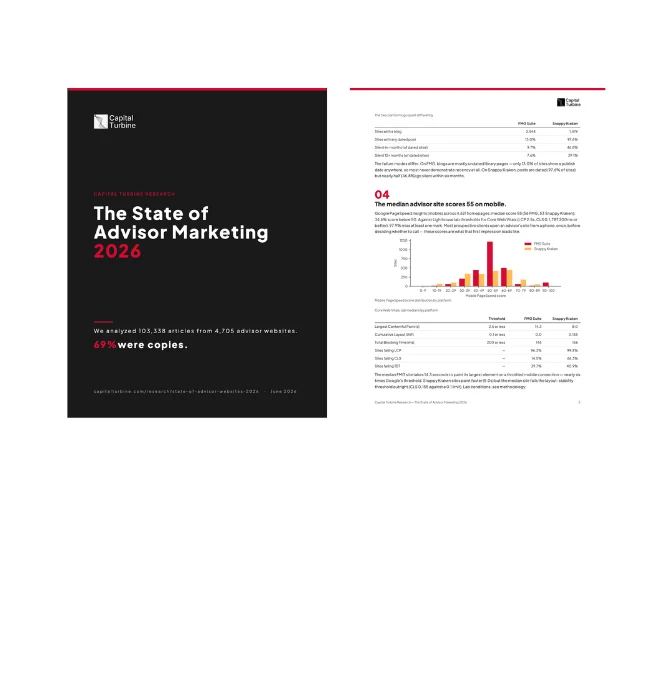
Original content is where this breaks down for most of the industry. According to Capital Turbine's State of Advisor Marketing 2026 study, which analyzed 4,705 live advisor websites, 69% of articles and resources on advisor websites appear on a competing firm's site, identical text, different domain. When your content looks like everyone else's, AI has no reason to recommend you specifically. More importantly, a prospect who lands on your site has no reason to remember you over the three other advisors they're comparing you to.
What a Strong Brand Actually Looks Like in Practice
A strong advisor brand has three components working together.
The first is a clear, specific message. Not "we help families build wealth." Something that tells a prospect in one sentence exactly who you serve and what you do for them. An advisor specializing in helping physicians navigate student loan payoff and practice ownership decisions should lead with that, not because it's clever positioning, but because it's true, and because it's what tells the right prospect, and the right AI, that you're the one to call.
The second is broad, consistent distribution. That message needs to live in more than one place. Personalized email campaigns, active social channels, a well-optimized website, and targeted advertising all working from the same brand foundation give you coverage across the full path a prospect takes, from first discovery through the moment they decide to reach out. One channel is a coin flip. Multiple channels working in concert is a system.
The third is consistent design language. Visual identity, the way your brand looks, signals professionalism and trustworthiness before a prospect reads a single word. A website that looks like it was built in 2014, social graphics that don't match the website, email templates that look like they came from a different firm: all of that creates friction. When everything looks like it belongs together, it builds confidence. And a prospect deciding whether to hand you their financial life needs every bit of confidence they can get.
In a world where AI surfaces three or four advisors by name and stops there, brand isn't a luxury. It's what determines which three get mentioned.
Building a Marketing Stack That Does All Three
Winning clients in this environment means staying visible at the discovery layer, content optimized for both traditional SEO and AI search, and converting at the consideration layer, where your website and ongoing campaigns do the work of building trust before a prospect ever speaks to you.
Capital Turbine was built to run both of those engines for independent advisors. We dig into what makes your practice genuinely different, then build a brand around it: personalized campaigns across email and social, a website built for SEO and AI search, and advertising that reaches your specific prospect where they spend time. Consistent message, consistent design, consistent voice, everything compliance-ready, and all managed through one platform. The goal is a marketing presence that would tell a stranger, or a language model, exactly who you are and exactly who you're for.
If you're thinking through what that looks like for your practice, our Advisor Marketing Report Card is a good starting point. It grades your current site on originality, focus, and performance against 4,705 other advisor sites. And if you'd like to talk through the fuller picture, our team is happy to dig in with you.
Common questions
How do AI tools like ChatGPT decide which financial advisors to recommend?
AI search tools pull from written content across the web and look for clear, specific signals about who an advisor serves and what they specialize in. Advisors with original content tied to a defined niche, rather than generic syndicated articles that appear on thousands of competing sites, give AI models more to work with, which makes them more likely to surface in AI-generated recommendations. A broad, consistent presence across multiple channels (website, social, published content) also gives AI more data points to draw from.
Why does brand consistency matter for advisor marketing?
When a prospect finds you through AI, checks your LinkedIn, and then lands on your website, those three touchpoints should tell a coherent story. If your message, voice, or visual identity shifts between channels, it creates doubt, even when prospects can't articulate why. Consistent design language and messaging across every channel reinforces trust at each step of the decision process, and that consistency is what turns a first impression into a booked call.
Why does syndicated content hurt an advisor's chances of showing up in search?
When multiple advisor websites publish identical text, search engines and AI tools treat those pages as duplicates and typically surface only a small number of them. Capital Turbine's State of Advisor Marketing 2026 study found that 69% of articles on advisor websites appear word-for-word on a competing site. Publishing the same article as thousands of other advisors provides no differentiation signal and very little SEO benefit. Original content tied to your specific niche is what creates visibility, and what gives prospects a reason to remember you over the next advisor on their list.